
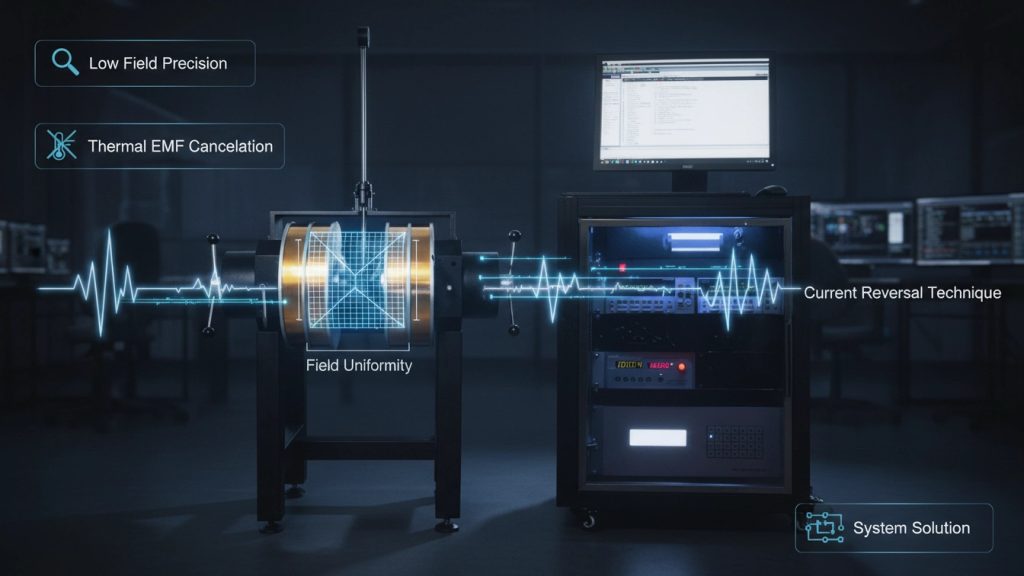
Low-field Hall measurements are deceptively difficult.
When magnetic fields drop into the µT to low-mT range,
errors that are negligible at high field suddenly dominate the data.
Two factors determine whether low-field Hall data is meaningful or misleading:
- Magnetic field uniformity at the sample
- Proper current reversal and measurement symmetry
This article explains why both are essential
and how they must be implemented at the system level.
1. Why Low-Field Hall Measurements Are Especially Sensitive
At low magnetic fields, the Hall voltage is small:
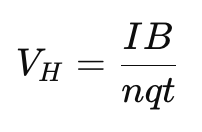
When BBB is small, any parasitic effect becomes significant:
- Contact resistance imbalance
- Offset voltages in voltage amplifiers
- Thermoelectric (Seebeck) effects
- Field gradients across the sample
Without mitigation, these effects can easily exceed the true Hall signal.
2. Field Uniformity Is Not Optional at Low Field
At high field, small gradients average out.
At low field, they do not.
What Goes Wrong Without Uniformity
- Different parts of the sample experience different BBB
- The measured Hall voltage becomes geometry-dependent
- Apparent carrier density varies with sample position
- Angular scans become irreproducible
For low-field Hall measurements, uniformity must be defined over the entire active sample area, not just at a single point.
3. Why Helmholtz-Type Coils Are Preferred at Low Field
Helmholtz and vector coil geometries are widely used because they provide:
- Large uniform field volumes
- Predictable field gradients
- Stable B–I conversion factors
This is why they dominate low-field Hall, magnetoresistance, and sensor calibration setups.
Uniformity is not a “nice-to-have” specification.
It directly determines data credibility.
4. Current Reversal: The Most Powerful Error-Cancellation Tool
Even with perfect field uniformity, electrical offsets remain.
Current reversal removes them.
Basic Principle
Measure Hall voltage with:
- +I, +B
- −I, +B
- +I, −B
- −I, −B
Then combine the results symmetrically.
This cancels:
- Contact resistance offsets
- DC amplifier offsets
- Thermoelectric voltages
Without current reversal, low-field Hall data should be treated with suspicion.
5. Why Precision Current Sources Matter More Than You Think
Current reversal only works if the current source is:
- Highly repeatable
- Low noise
- Stable during polarity changes
Poor current stability introduces new errors during reversal.
Key requirements:
- Low current noise
- Fast settling after polarity change
- Minimal thermal drift
This is why low-field Hall systems cannot rely on generic laboratory power supplies.
6. Field Reversal vs. Current Reversal
Field reversal further improves accuracy but adds complexity.
Field Reversal Advantages
- Cancels residual magnetic offsets
- Suppresses environmental field drift
Field Reversal Challenges
- Coil inductance limits speed
- Requires stable drivers and control logic
The most robust low-field systems combine:
- Precision current reversal
- Optional field reversal
- High field uniformity
7. System-Level Thinking: Why Components Must Match
Low-field Hall accuracy is never defined by a single component.
It depends on:
- Coil geometry and uniformity
- Precision current source performance
- Measurement sequencing and timing
- Thermal and electrical symmetry
Mix-and-match solutions usually fail here.
8. Practical Low-Field Hall Measurement Solutions
Cryomagtech provides integrated solutions for low-field Hall measurements, combining:
- Uniform Helmholtz or vector coil systems
- Precision excitation and reversal-capable current sources
- Hall Effect Measurement Systems designed for low-signal regimes
References
- Wikipedia – Hall effect fundamentals
https://en.wikipedia.org/wiki/Hall_effect - IEEE – Low-field Hall measurement techniques
https://ieeexplore.ieee.org/
Key Takeaways
- Low-field Hall measurements amplify hidden errors
- Field uniformity directly affects Hall voltage validity
- Current reversal is essential, not optional
- Precision current sources enable reliable reversal
- True accuracy requires a matched system, not isolated instruments
If your low-field data looks unstable,
the problem is usually not the sample.